Much and more has been said of late about Kazuo Ishiguro's latest novel, The Buried Giant, some great, some not so great. Ishiguro, it seems, is rather hesitant to label his book a fantasy, though it's set in Anglo-Saxon Briton. And there are ogres. And knights. And a dragon that breaths forgetfulness mist. But, of course, this book cannot be so easily categorized, as it deals with adult themes and national identity and yada yada blah blah.
Still, it is Ishiguro, and I've got a soft spot for English-speaking Asians who wear big, round glasses, so color me torn. Then I read this interview on Goodreads, and wouldn't you know it, but the interviewer, whose first name is a last name, so you know he's distinguished, opens with this little zinger in the preamble to the interview proper:
"But don't be fooled by the fantastical excursions into Tolkien territory: This is still very much a wise, and relevant, literary investigation..."
This is, frankly, insulting. As if excursions into the fantastic would normally have precluded any wisdom or cultural relevance from appearing in the work. The most limiting lie anyone has ever told themselves is that because they liked a thing as a child, that thing must be childish, and therefore unworthy of their adult attention. Works of fantasy suffer under such misperceptions all the time, but it should not be so.
All works of fiction are fantasy. A character is made no more real because he lives in Manhattan, rather than Narnia; they are both fake, plain and simple. The wisdom and relevance of a work are derived from the universal experiences made particular by the author in his characters. Such is recognized by the reader no matter the setting. It is not seen, but felt in the heart and in the mind.
For an example, let's take "Tolkien territory." Tolkien, a WWII vet, was much affected by his time serving his country, and that experience we can see reflected in Frodo, who upon returning to the Shire finds himself unsettled in a setting he once found familiar and comfortable. Frodo has been changed by his traumatic journey with the ring, so much so that, though his task is complete, and by all rights he should get his well-earned rest, Frodo feels compelled to leave his home and his loved-ones in an attempt to regain some measure of the inner peace he's lost. In the world of the 50's, when PTSD was still decades from being understood, and thousands had returned home from the battlefields of Europe to discover they too felt a similar anxiety in returning to their day-to-day, Tolkien's portrayal of Frodo's stoic disquiet bore massive cultural and emotional weight, and still does today.
I was incredibly disappointed after reading Ursula Le Guin's rebuke of Ishiguro earlier this week, but at least during this interview, he deftly handled (rather, side-stepped) the questions about genre perception and stigma, though this pacifism may be, in fact, a direct result of the admonitions he received from Le Guin and others like-minded. This interviewer, however, could not manage to purport himself with quite so much grace. He tipped his hand early as a literary bigot, and ruined what may have been an otherwise intriguing interview for me.
I may read this book. I may not. I suppose it will just depend on how relevant I'm feeling, and how wise.
Thursday, March 5, 2015

Wednesday, October 29, 2014
On THE LEGEND OF KORRA: The Avatar State

So the Legend of Korra's got me super confused. Again.
There I was, four episodes into season 4, and Korra seems to be traipsing all over The Last Airbender's memory once again. This time my beef was with her ability to assume the Avatar State.
The Legend of Korra has been nothing if not confusing, and at many points contradictory. The Avatar State is a perfect example. In TLA (The Last Airbender), we learned that the Avatar State was the current avatar's ability to channel his (or her) past lives in a way that gave he (or she) access to all the wisdom and power of his (or her) predecessors. Confusing? A little. Vague? Yeah, but whatever. Cool? Duh.
In TLA, the audience was made to think of the Avatar as an element-bending Dalai Lama. Both bald, both spiritual leaders, both with a fondness for red and yellow robes. And both were perpetually reincarnating spirits tasked with guiding the free world. Right, got that. To get metaphysical for a minute, the concept of the Avatar in TLA was that the avatar spirit never died, and was reincarnated in each new avatar. Each avatar was basically the same person, but in a different body, and with their own experiences. Aang was Roku. Roku was Kyoshi. So on and so forth. Again, confusing, but people rarely need (or want) their spiritual beliefs over-analyzed. Reincarnation is a common and accepted thing in several eastern philosophies. We went with it. Cool. Past lives. One in the same. Still got it.

But if you do over-analyze it, the nature of the Avatar raises some seemingly contradictory existential dilemmas: How can avatars be themselves AND someone else? If they're the same person, how can they still speak to one another individually, like different people? Korra should be able to remember BEING Aang, and Aang should be able to remember BEING Roku. Speaking to one's past life like a grandchild to a wise, loving grandparent seems redundant; why not get those memories and experiences in First Person POV? Korra IS Aang, just like you ARE you and I AM me. Sure, you COULD speak to yourself, but not to tell yourself what you already know. It's more of a comfort thing, at least for me, but who's counting?
The Legend of Korra attempted to solve all those fishy existential mysteries with Raava, the giant silver and white immortal Light Spirit that lives inside each Avatar like a bad case of ring worm. For the first time, the Avatar State was concretely defined; it was given a mechanism. The Avatar State was not, in fact, the channeling of past lives, but the channeling of Raava, who herself is connected to all the Avatars, past and present. She was the hidden telephone by which Aang spoke with Roku, and by which Korra spoke with Aang. The Avatars AREN'T all the same person, with the Avatar spirit. Raava IS the Avatar spirit, and each new Avatar is a vessel she chooses, an individual with his (or her) own soul. You could say Raava is the real Avatar, the ONLY Avatar. The human Avatars are just the sharks that little Raava suckerfish uses to hitchhike around the ocean. The Avatar Spirit is the Avatar, but the Avatar isn't the Avatar Spirit. God, that's confusing.
So what does that mean for the Avatar State? As I've just said, it's the channeling of Raava, who, through her connections with past Avatar souls, can make the current Avatar much more bad ass. It's like Korra's body is a Gundam suit (a giant, brainless, fighting robot, for the layman), and, normally, Korra's soul is the pilot, but during bursts of Avatar state, Raava (a.k.a. the Avatar Spirit) takes control of the Gundam and goes ham sammich on whoever is in the way.

I didn't understand this right away (can you blame me?), and so Season 3 of the Legend of Korra, especially the finale, was frustrating. "How can she achieve the Avatar State?" my little nerd heart cried out. "Zahir's poison shouldn't work, because Korra's connection to her past lives was severed last season!"
Excellent point, My Little Nerd Heart. I now think I have the answer, thanks to some Avatar Wiki.
The Avatar Spirit IS Raava. Raava is immortal, but can be "killed." This happened in the Season 2 finale. Unalaq (Korra's uncle and Season 2's Big Baddy) and the Darkness Spirit, Vaato, dragged Raava out of Korra and destroyed her. But there can be no darkness without light. Yin and Yang. Good and Bad. Raava was reborn inside Vaato, Korra ripped her out, they recombined, happy ending. But this Raava was not the same old Raava.
Think of it like hitting the Reset button on... something that has a Reset button. The old Raava had all these experiences and connections with past Avatars because she was there, swimming around inside them like a parasite of Goodness, but when she was destroyed and reborn inside Vaato, all that stuff was lost. This version of Raava has had all the factory defaults restored. No more past lives; this new Raava didn't know any of the old Avatars, just Korra. Korra is essentially the second "First" Avatar.

I think.
Okay, rant over. Thomas out.
Thursday, July 31, 2014
Quote for the Week of 7/28/2014
"I think you can't possibly know the truth about someone unless you love them."
-Orson Scott Card, Speaker for the Dead
-Orson Scott Card, Speaker for the Dead
SPEAKER FOR THE DEAD, by Orson Scott Card (5/5)
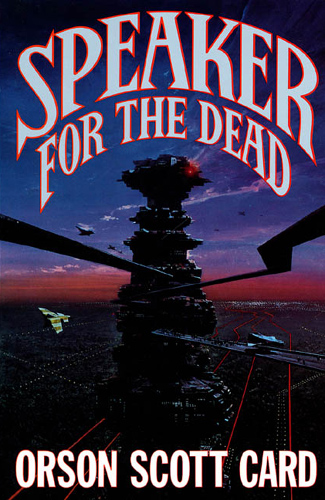
So I'm going to do some book reviews now. Not so much because I feel any particular need to make known my opinions, but because my memory, as far as memories go, isn't super, and in 8-12 months I know I'm going to need some sort of written aid to help me remember not only what happened, but also who did what, and what I liked about them. So yeah.
Speaker for the Dead:
I liked this book more than I thought I would. Loved it actually, and that was really surprising, because when I read Ender's Game about four years ago, my principle reaction was, Eh, kinda slow. The twist at the end blew me away, but struggling through 200 pages of cryptic dream sequence and battle school strategerie wasn't exactly my definition of "worth it."
Speaker for the Dead wasn't that. The stakes were monstrous right from the word "go," the characters were varied and relatable, and the world building felt so natural in its uniqueness that I never once felt the need to question it, even though, half the time, they spoke about it in Portuguese.
This book came out almost 30 years ago, so I'm a little late to the party, but I now get why Card is perhaps the biggest name in Science Fiction, ever. Ender's Game was Card's first exploration into Ender's world, and in several respects this was apparent. In Speaker, Card has perfected and mastered his world, and it makes this novel an exciting and thought-provoking read from beginning to end.
My beef with many works of SciFi is that the stories trend toward the unrelatable. The authors get so excited about their SciFi universe that the character development takes a back seat to the world development, and that rarely flies with me (pun intended), even in short stories, but especially in novels.
Not so in Speaker. The world feels so natural, so quickly, that both author and reader are free to focus on the tortured Novinha, the stoic Miro, and the singular Ender from the very beginning. It's the perfect storm of characters who fit naturally into their environment, even as the seek to change it.
My one criticism is small, but notable. For a work filled with deeply flawed, imperfect characters, Ender is surprisingly flawless. He's a genius, he's compassionate, he's perhaps the most perceptive and empathetic human being ever, and he's relentlessly driven to correct a wrong for which he, arguably, isn't to blame. He's pseudonymously published his own space-age humanist Gospel, inadvertently founded his own religion, he hates no one, understands everyone, and still has the time to become functionally proficient in Portuguese in under three weeks. All his B.M.'s are single wipers, he's pitch-perfect as both a Tener 1 and a Bass 2, and he's the most generous lover from here to Trondheim. Some guys just got it all.
And yet, despite his seeming perfection, Ender still manages to convince me of the difficulty of all his decisions, as though his 3000 year unbeaten streak were on the line with every one, and that's what makes him a true champion: he's got the goods, and he knows how to use them, just like this book.
5/5
Thomas out.
Thursday, July 10, 2014
On Pointing Fingers (Middle East Edition)
When it's time to play the blame game, you rarely find someone willing to point the finger at himself. (Time to use this here blog as my own personal pulpit for a minute, if you'll excuse me.)
Had a semi-heated conversation with someone today. It started over a video of a politician rebutting a young American Muslim woman over the idea that peaceful Muslims are being blamed for the actions of a few radicals. The politician made several good points, by way of analogy. Most Germans of the 1940's were good, peaceful people, but the Nazis still managed to kill millions of people. Most cold war era Russians were good, peaceful people, but the Soviet Union still killed millions of people. Most Japanese people were good, peaceful people, but the Japanese army still tore through east Asia during World War II. The woman's point was that defending the innocent majority is a politically correct, superficial gesture because the innocent majority was irrelevant; despite their own sentiments, they did not stop an evil entity (no matter how anomalous) from rising up and being allowed to control their culture.
Back to my conversation. Person 1 wants the good, peaceful Muslims to acknowledge that there is some issue intrinsic to Islam that predisposes its adherents toward radicalization. He wasn't saying that all Muslims were bad, or likely to become radical; he simply wanted Muslims stop pointing the finger at the US and take a gander at their own fuzzy navels. What exactly about Islam, Muslims should ask, is leading to this predisposition toward radicalization?
Person 1 used the example of the Catholic priest pedophilia scandal as an analogy. As a Catholic, you couldn't reasonably stand up and claim that the Catholic Church wasn't at least a little bit to blame for allowing those heinous acts to happen under its watch, right? Of course, that's reasonable. The Church really screwed the pooch on that one. Our bad, guys, we'll keep a closer eye on those pedos next time.
But just as it's not fair that the Catholic Church should shirk responsibility, it is also not fair that regular Catholics be made to answer for the crimes of the deviant. Is there something about Catholic teaching that led to a score of robed men molesting young boys? No, there is not. Is there something intrinsic to German-ness that predisposed its people toward Nazism? Also no. Is there something about proper Islamic teaching that's spawning terrorists in TNT-laden sport coats? Nope. That too is a false assumption.
There is such a thing as evil in this world. There is NOT such a thing as evil that arises in a vacuum.
Was Germany to blame for the rise of the Nazis? Yes. Was the Catholic Church responsible for the pedophilia scandal? Also yes. But you can't ignore the circumstances.
The original Nazi message wasn't "hey, lets go kill as many minorities as we can, that aught to make us feel better;" their message was "hey, the rest of Europe really screwed us with those war reparations, and it's looking pretty rough right now, but Germany was once great, and it can be great again, if you trust us."
Guess what those priestly pedophiles were, before they were priests. Any guesses? That's right. They were pedophiles. And last time I checked (which I admit, I haven't checked in a while, but I'll make an educated guess) on the application for Catholic seminary there isn't a Check Yes or No box for "Are you a pedophile?" Although there might be now. Who knows? Couldn't hurt.
The point is this--throughout the entire course of human history, when bad people are given an opportunity to gain power over others, they become very predictable. They deceive, they hurt, and they look out for #1. And the more it works out for them, the more they continue to do it. There isn't something wrong with Islam because a group of a-holes with an ax to grind have gone to one of the poorest regions in the world and spread misinformation and propaganda against the USA, then drawn the US into a decade-long struggle which, among other things, has reinforced their deceptions and hatred.
Was the US justified in wanting to root out Al Qaeda and eradicate them? I think so. Has it worked out so well for the Afghanis? Not so much. When the jerk who lives down the street and the jerk from out of town are shooting missiles back and forth across your front yard, the jerk from out of town might be justified in trying to blow your neighbor up, but who are you most likely going to blame when a rocket blows up your cat? Not the guy you're going to have to live with, when the fight is over. Better the devil you know, than the devil you don't.
To bring it back home, when we go out and about looking for someone to blame, don't expect anyone to stand up and volunteer their head for the chopping block. Unless he's the Brazilian National Team coach. That guy's a class act. And that mustache? Top notch.
During the pedophilia scandal, every Catholic with any kind of sense was quick to stand up and say, that's not us. That's not Catholicism. We reject those men as deviants who have abused their power and betrayed their faith.
After WWII, every German with any kind of sense stood up and said, hey, don't blame me! How was I to know? Those men lied to us all. I'm sheltering five Jews, three Gypsies, and a lonely Pollock in my sub-basement right now, go check.
Good people should always step up to fight against evil, especially when that evil has arisen within their own culture, but just because these people have a responsibility to fight against it doesn't mean they have a responsibility to answer for it. The nation of Islam, as a people, is partially to blame for allowing the recent rise and propagation of anti-Western radicalism. I think that's fair. But they should not be made to admit that something fundamental to the Islamic faith is the root of the problem. People looking for that admission just want something to blame, something to condemn. They fear the radical minority, but can do nothing about it, and so they need someone who is willing to step up and take their blame bullet. Somebody who won't shoot back.
But in the immortal, aphoristic words of Yoda, "Fear leads to Anger. Anger leads to Hate. Hate leads to the Dark Side." Start playing the blame game, and before you know it, somebody's making a trio of underwhelming prequels about your tragically misguided youth. And nobody wants that.
Thomas OUT.
Had a semi-heated conversation with someone today. It started over a video of a politician rebutting a young American Muslim woman over the idea that peaceful Muslims are being blamed for the actions of a few radicals. The politician made several good points, by way of analogy. Most Germans of the 1940's were good, peaceful people, but the Nazis still managed to kill millions of people. Most cold war era Russians were good, peaceful people, but the Soviet Union still killed millions of people. Most Japanese people were good, peaceful people, but the Japanese army still tore through east Asia during World War II. The woman's point was that defending the innocent majority is a politically correct, superficial gesture because the innocent majority was irrelevant; despite their own sentiments, they did not stop an evil entity (no matter how anomalous) from rising up and being allowed to control their culture.
Back to my conversation. Person 1 wants the good, peaceful Muslims to acknowledge that there is some issue intrinsic to Islam that predisposes its adherents toward radicalization. He wasn't saying that all Muslims were bad, or likely to become radical; he simply wanted Muslims stop pointing the finger at the US and take a gander at their own fuzzy navels. What exactly about Islam, Muslims should ask, is leading to this predisposition toward radicalization?
Person 1 used the example of the Catholic priest pedophilia scandal as an analogy. As a Catholic, you couldn't reasonably stand up and claim that the Catholic Church wasn't at least a little bit to blame for allowing those heinous acts to happen under its watch, right? Of course, that's reasonable. The Church really screwed the pooch on that one. Our bad, guys, we'll keep a closer eye on those pedos next time.
But just as it's not fair that the Catholic Church should shirk responsibility, it is also not fair that regular Catholics be made to answer for the crimes of the deviant. Is there something about Catholic teaching that led to a score of robed men molesting young boys? No, there is not. Is there something intrinsic to German-ness that predisposed its people toward Nazism? Also no. Is there something about proper Islamic teaching that's spawning terrorists in TNT-laden sport coats? Nope. That too is a false assumption.
There is such a thing as evil in this world. There is NOT such a thing as evil that arises in a vacuum.
Was Germany to blame for the rise of the Nazis? Yes. Was the Catholic Church responsible for the pedophilia scandal? Also yes. But you can't ignore the circumstances.
The original Nazi message wasn't "hey, lets go kill as many minorities as we can, that aught to make us feel better;" their message was "hey, the rest of Europe really screwed us with those war reparations, and it's looking pretty rough right now, but Germany was once great, and it can be great again, if you trust us."
Guess what those priestly pedophiles were, before they were priests. Any guesses? That's right. They were pedophiles. And last time I checked (which I admit, I haven't checked in a while, but I'll make an educated guess) on the application for Catholic seminary there isn't a Check Yes or No box for "Are you a pedophile?" Although there might be now. Who knows? Couldn't hurt.
The point is this--throughout the entire course of human history, when bad people are given an opportunity to gain power over others, they become very predictable. They deceive, they hurt, and they look out for #1. And the more it works out for them, the more they continue to do it. There isn't something wrong with Islam because a group of a-holes with an ax to grind have gone to one of the poorest regions in the world and spread misinformation and propaganda against the USA, then drawn the US into a decade-long struggle which, among other things, has reinforced their deceptions and hatred.
Was the US justified in wanting to root out Al Qaeda and eradicate them? I think so. Has it worked out so well for the Afghanis? Not so much. When the jerk who lives down the street and the jerk from out of town are shooting missiles back and forth across your front yard, the jerk from out of town might be justified in trying to blow your neighbor up, but who are you most likely going to blame when a rocket blows up your cat? Not the guy you're going to have to live with, when the fight is over. Better the devil you know, than the devil you don't.
To bring it back home, when we go out and about looking for someone to blame, don't expect anyone to stand up and volunteer their head for the chopping block. Unless he's the Brazilian National Team coach. That guy's a class act. And that mustache? Top notch.
During the pedophilia scandal, every Catholic with any kind of sense was quick to stand up and say, that's not us. That's not Catholicism. We reject those men as deviants who have abused their power and betrayed their faith.
After WWII, every German with any kind of sense stood up and said, hey, don't blame me! How was I to know? Those men lied to us all. I'm sheltering five Jews, three Gypsies, and a lonely Pollock in my sub-basement right now, go check.
Good people should always step up to fight against evil, especially when that evil has arisen within their own culture, but just because these people have a responsibility to fight against it doesn't mean they have a responsibility to answer for it. The nation of Islam, as a people, is partially to blame for allowing the recent rise and propagation of anti-Western radicalism. I think that's fair. But they should not be made to admit that something fundamental to the Islamic faith is the root of the problem. People looking for that admission just want something to blame, something to condemn. They fear the radical minority, but can do nothing about it, and so they need someone who is willing to step up and take their blame bullet. Somebody who won't shoot back.
But in the immortal, aphoristic words of Yoda, "Fear leads to Anger. Anger leads to Hate. Hate leads to the Dark Side." Start playing the blame game, and before you know it, somebody's making a trio of underwhelming prequels about your tragically misguided youth. And nobody wants that.
Thomas OUT.
Wednesday, July 9, 2014
Quote of the Week for 7/7/14
"Man is least himself when he talks in his own personae. Give him a mask, and he will tell you the truth."
-Oscar Wilde
-Oscar Wilde
On Podcasts
I've found my new thing that I'll be really into for a while.
I've got to thank my brother for this one. I'm a visual learner (my excuse for mediocre grades on all my Spanish listening exams), and usually have a tough time concentrating on and engaging with aural media, but early this spring he suggested I try a podcast out for one of my frequent 7 hour drives between Nashville and Winston-Salem, North Carolina, and I've been hooked ever since.
I'd always struggled to stave off the boredom during the marathon trips, but podcasts proved to be the perfect solution. No hunting for a good local radio station, no droning monotone of a book on tape, just interesting people talking about interesting things for a couple hours at a time. You can find a podcast for just about anything you're interested in, but I find the podcasts of comedians the most entertaining. Turns out funny people can be funny all the time, talking about anything, not just when their reciting a script or performing a stand up.
I started out with the Joe Rogan Experience, 1) because his podcasts are 3 hours apiece, 2) he consistently brings on very interesting and insightful guests, and 3) because it's the only one I knew about. It was a good choice. Joe Rogan is the perfect mix of entertainer and pseudo-intellectual to keep an audience engaged, laughing and thinking, for the full 3 hours. Turns out he's the 2nd most popular podcast in the world for a reason. And maybe the best part was that many of his guests had podcast of their own, and my tastes quickly expanded out from the JRE.
My podcast consumption is now what one might call "next level." Enabled by the aforementioned frequent road trips, I diversified my listening experience to include such auditory gems as Bill Burr's Monday Morning Podcast, Fighter and the Kid with Brendan Schaub and Bryan Callen, and several Grantland podcasts including the Andy Greenwald podcast and my personal favorite, Men in Blazers. The podcast, more than anywhere else, is a medium perfectly suited for showcasing great personalities, and all long as people continue to support these personalities, the entertainment potential is potentially limitless.
There are podcast streaming and downloading apps available for both the iPhone and Android. I use the aptly named Podcast Addict. Try it out. You'll either like it or you won't, but it's free and it's different, and did I mention it's free?
Thomas out.
I've got to thank my brother for this one. I'm a visual learner (my excuse for mediocre grades on all my Spanish listening exams), and usually have a tough time concentrating on and engaging with aural media, but early this spring he suggested I try a podcast out for one of my frequent 7 hour drives between Nashville and Winston-Salem, North Carolina, and I've been hooked ever since.
I'd always struggled to stave off the boredom during the marathon trips, but podcasts proved to be the perfect solution. No hunting for a good local radio station, no droning monotone of a book on tape, just interesting people talking about interesting things for a couple hours at a time. You can find a podcast for just about anything you're interested in, but I find the podcasts of comedians the most entertaining. Turns out funny people can be funny all the time, talking about anything, not just when their reciting a script or performing a stand up.
I started out with the Joe Rogan Experience, 1) because his podcasts are 3 hours apiece, 2) he consistently brings on very interesting and insightful guests, and 3) because it's the only one I knew about. It was a good choice. Joe Rogan is the perfect mix of entertainer and pseudo-intellectual to keep an audience engaged, laughing and thinking, for the full 3 hours. Turns out he's the 2nd most popular podcast in the world for a reason. And maybe the best part was that many of his guests had podcast of their own, and my tastes quickly expanded out from the JRE.
My podcast consumption is now what one might call "next level." Enabled by the aforementioned frequent road trips, I diversified my listening experience to include such auditory gems as Bill Burr's Monday Morning Podcast, Fighter and the Kid with Brendan Schaub and Bryan Callen, and several Grantland podcasts including the Andy Greenwald podcast and my personal favorite, Men in Blazers. The podcast, more than anywhere else, is a medium perfectly suited for showcasing great personalities, and all long as people continue to support these personalities, the entertainment potential is potentially limitless.
There are podcast streaming and downloading apps available for both the iPhone and Android. I use the aptly named Podcast Addict. Try it out. You'll either like it or you won't, but it's free and it's different, and did I mention it's free?
Thomas out.
Subscribe to:
Posts (Atom)